"The Sociological Production of the End of the Pandemic" (02/04/21)
Note: This episode originally aired February 4th 2021 under the title “Covid Is Over (If You Want It) (02/04/21)” just two weeks after Biden’s inauguration. We consider this to be the episode where the concept that would become Death Panel’s framing of “the sociological production of the end of the pandemic” was first articulated.
The following is a transcription of a version of this episode that re-aired under the title “The Sociological Production of the End of the Pandemic (05/11/23)” with an added introduction on May 11th, 2023—the day the Biden administration declared an end to the covid Public Health Emergency.
With the public health emergency declaration ending today, May 11th, we turn back the clock to early 2021, mere days into the Biden presidency, and the moment it became clear the US was going to "end the pandemic" not by stopping covid, but by re-narrating its social and political meaning.
As always, support Death Panel at www.patreon.com/deathpanelpod
Transcript by Kendra Kline. (Kendra is currently accepting freelance transcript work — email her if you need transcripts or visit her website)
Voice-over 0:01
February 25th, 2021.
Phil Rocco 0:05
But I think the reason that this matters is that at some point the federal government will have to decide when the pandemic is over. And while I think we might want that decision to be grounded firmly in some sort of epidemiological reality, I think the very real possibility is that this determination will be fundamentally sociological and political.
Death Panel 0:54
[intro music]
Beatrice Adler-Bolton 1:01
Welcome to the Death Panel.
So today, the day we're recording this, is May 11th, 2023, and at the end of the day today, the official declaration of a federal public health emergency for COVID-19 in the United States will end. So to mark this occasion, we have something a little different and unusual for you today.
Artie Vierkant 1:24
Yeah, you know, we've talked a lot about how exactly we wanted to mark the end of the public health emergency. Do we focus on this angle? Do we want to focus on that angle? Is this another opportunity to simply repeat ourselves that this isn't over until everyone is safe? And in the end, something unusual happened.
So as we were talking on Monday in the Patron feed about the way that this moment, the end of the public health emergency, was likely to engender a lot of attempts to make or really deny meaning from these last three years and to attempt to close the book on the ongoing crisis, we thought to look back ourselves. And one of the things we wanted to reflect on was this rather clunky terminology that we came up with together many years ago to explain what was going on around us and what we saw, which we referred to as, and have been using since, as the "sociological production of the end of the pandemic."
Beatrice Adler-Bolton 2:22
So Artie and I listened back to a set of conversations that he, Phil and I had in early 2021 when this first became a central theme of our analysis, and when we listened back to the conversation that really finally crystallized that terminology, not to be dramatic, but it felt like the weight of that normalization process just really fell over us.
Artie Vierkant 2:44
Yeah. So today -- I'm just gonna say this right now, today, May 11th, the day the Biden administration selected to mark the very end of the public health emergency, just exactly 1,200 days from when the public health emergency began.
Beatrice Adler-Bolton 2:58
Hold on. Just let that sink in for a second. Exactly 1,200 days from the first day.
Artie Vierkant 3:03
Yeah. Today, we have nothing profound to say, nothing to add really. We're going to continue to have more to say in the future. But today, we're going to share our version, Death Panel's version of a moment of silence, if you will. So instead of bowing to the arbitrary end date that's set to ensure the perpetuation of GDP and allow Biden to have declared victory over the virus by 2024, instead of getting caught up in this completely fake event standing in as an end date, doing something like chiming in with our own summary of events thus far, instead we're going to turn back the clock and leave you with this conversation from February 2021, that says everything that we actually want to say today.
Beatrice Adler-Bolton 3:52
Mhm. And now, before you switch us off, just trust us -- everything that you're about to hear, which again, was recorded just weeks into the Biden presidency, feels as true today as it was then. This conversation was originally called, "Meaning Production at 500,000 Dead." It was the episode we recorded to mark the 500,000th US COVID death and to try and understand what was about to happen based on everything we understood at the time about Biden's intentions coming into office and also the political attitude of governors at the time.
Artie Vierkant 4:29
Yeah. And in many ways, this conversation, you know, it may be from two years ago, but in a very literal sense, the conversation you're about to hear is about today.
Beatrice Adler-Bolton 4:40
Yes.
Artie Vierkant 4:40
It is about May 11th, 2023 -- a date with no real meaning, a date that stands in for the outright denial, actually, I think, of the meaning that we could have made from the last three years and millions dead, so.
Beatrice Adler-Bolton 4:57
So with that, take care of each other and stay alive another week. We'll see you then.
Voice-over 5:02
[time travel music] February 25th, 2021.
Beatrice Adler-Bolton 5:13
Welcome to the Death Panel. Thank you to all of our new patrons. If you'd like to support the show, become a patron at patreon.com/deathpanelpod. For $5 a month, you get access to all of our weekly bonus episodes, which come out on Mondays. You get access to our entire back catalog and a discount on merch. Also leave us a rating or review on Apple Podcasts, send episodes to your friends. I don't know, people ask us all the time like, how could I help? And really, it's just post, please, is really all I can say.
Phil Rocco 5:45
Yeah, be part of the posting brigade [laughter], you know?
Beatrice Adler-Bolton 5:48
The street team.
Phil Rocco 5:48
The global posting brigade.
Beatrice Adler-Bolton 5:49
You know, remember those, street teams? Never mind. Cut that out. [Phil laughing] Anyways, so speaking of Patron episodes, in July, we did an episode called "The New Normal," where we tried to explain the narratives, framing and actions that allowed COVID deaths to be so dramatically normalized. That was, what, six months ago now? Seven? It's been a little bit since then, so I think it would be good -- we were thinking it would be good to revisit --
Artie Vierkant 6:15
Well, and it's been a lot of death --
Beatrice Adler-Bolton 6:18
How many deaths more?
Artie Vierkant 6:19
Since then -- when we recorded that, the tally in the United States was at 142,000.
Beatrice Adler-Bolton 6:24
And this week, we've just sailed past 500,000.
Artie Vierkant 6:29
Yeah. And not to make this too US-centric, although a lot of the stuff that we'll be talking about in terms of making some sort of meaning from this situation to the extent that we can, despite the fact that I think that as much as possible, the US political economy wants to reject --
Beatrice Adler-Bolton 6:44
Meaning [laughing].
Artie Vierkant 6:45
Possibly the global political economy wants to reject meaning in this instance. But, yeah, not to make it too US-centric, but the EU as of yesterday also passed 800,000 deaths.
Phil Rocco 6:56
Yeah. And I feel like, you know, the thing that we -- we sort of were thinking about this term, like normalization of death, in the summer. And I feel like one thing we didn't really capture is just how variable and how many different ways there are to normalize death. I mean, in the summer, we were really talking about people in government trying to avoid responsibility for the fact that the virus was checked -- kind of going on unchecked, but now -- but there's a different way in which one could normalize deaths, which is to say, not about sloughing off responsibility for why people are dying in the present, but mystifying and compounding and conflating the reasons that they died in the past, which actually performs a very different I feel like political function. One is about trying to get leverage to do something else in the present, and the other is a kind of project of like moral absolution. It's a way of trying to get out of this without anybody having learned anything.
Artie Vierkant 8:04
Well, but also I think you're pointing to a really big divide and problem in this overall discussion, right, which is that we do talk about -- you know, we talk about this as a pandemic, but we do still talk about COVID-19 and the experience and all this stuff as this sort of individual, whether it's personal responsibility, all the way down to personal experience, to like -- you know, it may be this huge figure, this huge amount of cases and this huge amount of deaths, but then every one of those is still treated as this individual experience and not some sort of collective event.
And at the same time, it's like, you know, we -- I think -- I think so much of this, and this was a problem already when we were talking about it at 142,000 deaths, when we were talking about how those -- how that number gets naturalized, how it gets normalized, of like how many deaths were happening. And we've talked about this most recently again, when we were in a period where we were having 4,000 deaths a day, as -- you know, as actually captured and logged.
But that problem, that tension, of having this huge number -- 500,000 deaths, right -- and then it's almost like the bigger that it gets, the more difficult it is to like synthesize what it actually means. I think this was put really well in -- I've been reading Mike Davis's book about the avian flu, and right at the beginning he talks about this, and I think the way that he puts it is really apt: "No one mourns a multitude or keens at the grave side of an abstraction." And I think that what we have basically is this ever-growing abstraction mixed with these concerted efforts, really, to keep that in the realm of abstraction.
Beatrice Adler-Bolton 9:43
Right. And this sort of process of individuation that we talk about all the time on this show, it is one of the most constant drivers behind the abstraction and behind this kind of demotivation of action, too. Because when you take something that is terrifying like COVID is -- like COVID is objectively terrifying, right? Like a lot of illness is objectively terrifying. This is -- I don't know, I feel like that's pretty surface level, right, but it's worth stating. When you take something this scary, that people have so little conception of how to be safe around it, right, and you gaslight them, and you tell them it's because it's their neighbor is hanging out with people in their living room, and you do everything you can as a society to push away the idea that there could be something like fundamentally wrong in our political will.
Artie Vierkant 10:39
Or in our political economy, I would say.
Beatrice Adler-Bolton 10:40
Right. Yeah. What you do, what you do to people is you make them feel alienated, you make them feel powerless, you make them feel responsible. And this, at the end of the day, is just fueling the lack of -- the lack of acknowledgement of what's actually going on, which is only maintained by this constant social reproductive process of abstraction.
Phil Rocco 11:08
Yeah, I kept thinking of the phrase, which I have to imagine began in a pop song, but is, I think -- with the beginning of the pandemic, I began seeing this phrase crop up more and more as a way of describing how to experience social distancing, which was the phrase "alone together." And the meaning of that, you know, ostensibly, the way it was used in the early days of pandemic, was like one could be alone in your house, but connected to other people virtually in some way.
But the way that it increasingly registers for me now is that we can have this collective experience of death, but there's no way of talking about what we might collectively do about it. We mourn -- you know, there's a candle lighting ceremony, flags are at half staff, and we mourn publicly the 500,000 dead with a moment of silence. We depict their deaths with -- you know, used to be names, but now as a scatter plot on the front page of The New York Times, which is one of the most -- just, just worst images that I've ever seen. It just -- just even as a matter of basic statistical presentation makes no sense.
Artie Vierkant 12:19
Or as a representational choice, my God, I mean, it says everything, right?
Phil Rocco 12:23
Yeah.
Beatrice Adler-Bolton 12:23
Yeah, what better --
Artie Vierkant 12:24
It goes from individuation, quite literally, to, you know, well, fuck, I don't know, just throw a chart up. Like, how are we gonna do that? We're not gonna -- we're not gonna print all these names, etc., you know.
Phil Rocco 12:36
Yeah. The ironic thing is that there's this -- still a sense that COVID is one's -- the individual risk one takes on and maybe what one's own characteristics, prior behaviors, demographic characteristics project onto it, but at the same time, the representation of people as dots suggests that the only good thing about individuation, the idea that people are people with names and lives and people that they've left, is sort of abstracted from that entirely.
And so it's -- when people ask this question of how does this end, or how do we know when it's like "over," one issue is that there's no sense of a common goal that we should be striving for. It's like, when can we go back to the -- not even thinking about the possibility that there would be something we'd have to do collectively? When can we go back to just pure negative liberty in thinking about this?
And I think that's been reflected from the beginning in the way that all of the gating criteria and plans were laid out. Gating criteria only ever went one way. There was no sense that cyclicality was going to be a part of it. No sense that at some point we would have to change the way that we were, or change the way that our institutions worked, or whatever. And so I have to imagine that there's -- that is something that will fundamentally define the way that the future works.
And the idea that, oh, there are four different futures, and maybe it could be just tragic business as usual -- that presupposes that people will understand and actually continue to care, and don't have all of the incentives in the world to engage in collective -- not just forgetting, because I think that's part of it, but also, the treatment of the past as something to mourn rather than to understand or to learn from.
Artie Vierkant 14:49
When you mentioned gating criteria, you're talking about like phased reopening stuff, or --
Phil Rocco 14:53
Yeah, the phase reopening things.
Beatrice Adler-Bolton 14:55
Yeah. It's interesting actually, when you mentioned the gating criteria, it struck me as odd early on, that when we were starting to see the first plans released around April and May of "reopening" strata, right, you only see thresholds for moving forward really. You see some people, like I guess to Bill de Blasio's credit -- it sounds weird to say that -- to Bill de Blasio's credit, early on, New York City did actually have backwards gating criteria that they were really touting out and talking about publicly.
But even just like by July, by September, when you start to really hear the school reopening debate hit a fever pitch, you stop seeing people acknowledge that we need a plan for what happens if we're back in COVID. Because the primary social reproductive responsibility of all these lawmakers has been to create, I guess, hope and forward moving momentum, not to actually focus on dealing with this extended, protracted middle that's absolutely devoid of meaning, which is actually where we're at, and where we've been for a year.
And this is something that I think is inherent in the way that we as a -- that we as a society [laughing] think about illness in the abstract, right, which is that you get sick, you get health care, and maybe you don't get health care and you die, but you get health care and then you either die or you're better. But this virus, and the way that viruses work and the way that epidemics work is absolutely not like that. Most people's experience of illness is absolutely not like that. The idea that illness is a discrete event that is experienced for a moment, and then you return to normal, ignores the actual realities of how the body experiences illness, what's going on in the body, and also how we're experiencing COVID.
And I think that there's this sort of decay in the idea of permanence that is really fundamental to a lot of the cover that people are building for themselves, the indemnity, right? This idea that any moment now, COVID will be over. But we've been living under this assumption of any moment now, COVID will be over, we'll find that silver bullet, for over a year at this point.
Artie Vierkant 17:24
Yeah, well, I mean, and I think maybe this would be a good time to sort of sketch out a trajectory of how we went -- basically how we got to here, because I think it's been this kind of ever moving target in terms of how this normalization process has been sold.
Phil Rocco 17:40
And I also -- yeah, I think we're gonna be firmly in the realm of elite discourse and elite framings of this. But -- which one might say, like, who cares, I don't want to read the Atlantic, and I never will, which God bless you, you shouldn't.
Artie Vierkant 17:54
I try not.
Phil Rocco 17:55
But like -- yeah, I try very hard not to. But I think the reason that this matters among -- one reason, among others, is that at some point the federal government will have to decide when the pandemic is over. And while I think we might want that decision to be grounded firmly in some sort of epidemiological reality, I think the very real possibility is that this determination will be fundamentally sociological and political.
Artie Vierkant 18:30
Yeah, absolutely.
Phil Rocco 18:30
And that there will, in fact, be different sort of endings, and all of that matters for the programs that we've created, that -- that relief of various kinds is contingent on and so, like, I want to do this in part because I think we need to think about who is driving us towards which sunset.
Artie Vierkant 18:55
Right.
Beatrice Adler-Bolton 18:56
Right. Yeah, so there's been this narrative from the beginning of COVID that a lot of the death that we're seeing is people that were gonna die anyway, right? That COVID deaths were being pulled from the future and so I think --
Artie Vierkant 19:14
That they were somehow inevitable, right? Yeah.
Beatrice Adler-Bolton 19:16
Right. Yeah, that these were deaths that were preordained to happen, we're just like cashing in on the deaths a little bit early.
Artie Vierkant 19:23
Yeah, more crassly, to quote one edgelord from last year, that "We know who is at risk."
Beatrice Adler-Bolton 19:31
Mhm. Maybe they had a secondary condition, maybe they were older, maybe they were overweight, maybe they had high blood pressure, maybe they had diabetes. And there's been this -- this drive to prove and certify, as much as we can, that people who died from COVID almost -- not that they deserved it, but that it makes sense that they died. And this whole making sense of the death has been about trying to draw a line in the sand between the people who have died and the people who have not died, that doesn't place the blame on the political economy, that doesn't place the blame on those in power, but places the blame on the individual and their individuated experience of health, which has dictated their outcomes in this pandemic.
Phil Rocco 20:20
Yeah, this is the idea -- I think in Britain, the -- or in the UK, the line that COVID skeptics I guess were using was that people were being referred to COVID deaths if they died *with* COVID, not because of it.
Artie Vierkant 20:38
Right.
Beatrice Adler-Bolton 20:38
[sighs]
Phil Rocco 20:38
Which just -- which fundamentally misunderstands the way that the classification of deaths occurs and how cause of death is actually produced through like causal linkages between things. But, you know, that thinking still persists, the idea that, like, because you have emphysema and you had COVID, that somehow your death should not be listed as a COVID death, even if COVID was the thing that actually produced the symptoms that led you to die. That thinking, I think, it's not the kind of thing you're going to pick up in surveys, but I think it is still out there latent in the population.
Artie Vierkant 21:17
Yeah. Well, you know, it's like, it's cause of death of most convenience, right? I mean, now I think -- I think if there's one thing in terms of the understanding of public health that I think is probably -- I mean, I think there are a number of things related to pandemics and public health and the political economy that have sort of filtered up as like watch words or terms that I think a broader -- a much broader section of the general public understands now, but among them is the term comorbidity, right? Which, you know, obviously there are things, like if you die from let's say the flu, and you have a heart condition, it's possible that you could be coded as one of the 600,000 deaths a year from cardiac conditions, right, as opposed to complications from like --
Beatrice Adler-Bolton 22:04
The flu.
Artie Vierkant 22:04
The flu, etc. When I say of most convenience, I mean that it creates this scenario where you can -- you essentially get to tell the story that you want with the data that you get, right?
Beatrice Adler-Bolton 22:17
Yeah. I mean, for me, one thing that I can't stop thinking about is just, you know, we have all these different systems of labeling that try and make meaning and try and help us understand and find patterns in the things that happen to human beings in the course of a natural life, but we act as if these meanings almost are devoid of any sort of bias or beyond manipulation, because there's this false idea that what is on the death certificate and what is being reported is somehow empirical. That ignores so many of the factors that are going on in this making of meaning process, where we say, you know, what is actually going on when we say someone who died as a result of getting the flu died of heart failure, right? We're minimizing the flu as something that we need to take social responsibility for ultimately.
Phil Rocco 23:23
Right.
Beatrice Adler-Bolton 23:23
And we're seeing this process happen in a way that moves forward and backward in time right now when it comes to COVID. It's not just one fixed revision. It's this sort of constant blanket revision of both directions and time.
Phil Rocco 23:39
Yeah, I mean, it's -- I want to -- can I make -- this might be a sidebar, but I think it's useful. So the deaths from Hurricane Maria in Puerto Rico, there was that big controversy, you know, Trump said like, all of these people didn't die. But the reason that those deaths were not recorded initially was actually sort of somewhat more mundane, which is that the death certificates which were used to produce the first count the Puerto Rican government released, people didn't put hurricane in the death certificate, which the CDC recommends that you do.
Now, here's the interesting thing, eventually the statistics were revised, and you got a much better projection of the number, which is like in the 1000s, obviously. But that didn't actually change anything either, because the money was still not forthcoming from Congress, because Puerto Rico has no representation in Congress, and not because we didn't have the numbers right, which suggests that something is going on here that's not just about sort of the expert understandings or the many foibles of coding and labeling deaths. What's going on here is, in part, a social process of coding, right, what deaths matter and what exactly is the acceptable political response?
Beatrice Adler-Bolton 25:04
I mean, I'm biased, but I think part of the reason why this process happens, is because we have some fundamental issue with illness as a social construct. And I think what we're seeing in COVID in particular, both with deaths, but also in terms of Long COVID, is this problem with our fundamental conception of how illness works in the body and how illness works as a social factor too.
Because you would think that with the amount of people with Long COVID, right, that you would see some recognition of that suffering and some sort of political will or motivation to ameliorate some of the things that are exacerbating it, like making sure that people who are discharged from the hospital can get oxygen. You have incredibly high rates of people who are hospitalized for COVID, who are discharged, who are dying after they're discharged.
This should warrant some reexamination of our discharge procedures, of our home support procedures. How are we checking in with patients? How is charting going? What's going on with primary care? But of course, this is absolutely never on the table. No one is discussing this in like a large way. And my own experience of chronic, protracted illness has been that people really have a hard time with the idea that something relating to illness can go on indeterminately, and they don't really deal with that temporality well.
People want illness to be over or kill you, and they don't really like having to deal with this long, protracted idea of this sort of threat, and they don't really know how to talk about it. And I think we don't have a lot of policy to deal with it. We don't have a lot of motivation or will to deal with any of this kind of stuff. And that sort of bias, which underlies so many aspects of our political economy, is just absolutely rampant right now.
Phil Rocco 27:09
Yeah, and this was, I think, if you were to go back and read news coverage from the spring, this was one of the more dominant themes, right? The idea that, well, this is the number of deaths, this is the number of cases. But when you look close up, there's a lot of heterogeneity, which is true. But then the move was that the explanation for that heterogeneity could not somehow rest in decisions that people who had governing authority could have made about protecting those people. That in a sense, those people were the people who were predisposed to die, whether or not they were in a nursing home or living in a community where there was community transmission, that somehow, that that was all baked into the cake and that there was nothing anybody could do.
Now, I think that was sort of the first phase, but I think over time, at least in public discourse, whether or not that lasted in the minds of many people, I will never know, and I've not seen good survey evidence on it to suggest, but I think it did. That's my sense. And just I've had conversations with people in which such utterances were made in recent weeks. But the phase that we moved to, I don't think that that phase lasted that long, I mean, at least in terms of elite discourse. I think that at some point, the discourse evolved towards something else, something closer to, you know, it all happened so fast. And regardless of why people died, there were just things that we didn't know and could not have done.
Artie Vierkant 28:55
Right. I think that's a really important point. And I think that this line of like, oh, it all happened so fast and like, if only we could have known, etc., before basically, there was a huge outbreak in the United States, there was this email chain among a bunch of public health people and clinical researchers at a variety of hospitals across the country, looking at the data coming out of Wuhan, looking at the data coming out of Italy, which, if you recall, at the very beginning of the pandemic, there was the whole thing of like, oh God, the US could be like Italy in two weeks.
And what they were -- what they were doing is they are -- before there was a confirmed case in New York City, and when there were only a few confirmed cases around the United States, one of them wrote the following. And when the term NPI is used here, that's non-pharmaceutical intervention, and think of this as, you know, when we talk about lockdowns and things like that, a lockdown, like a paid, everyone stay at home lockdown, is an example of a non-pharmaceutical intervention that we've advocated for.
They're not -- you know, these are kind of technocratic, whatever, public health people. They're not necessarily -- they weren't explicitly advocating for something like that, but they were talking about how Italy had implemented a cordon sanitaire late, or a lockdown late. So this is in one of the emails, again, from -- I think this one may be from March 2nd -- "We usually think of the window for implementing NPIs [non-pharmaceutical interventions] as before 1% prevalence in the population, but this disease would be predicted to have more than 80% asymptomatic. [That's back of the envelope math for them at the time.]
So the threshold is really 0.2% prevalence of any symptoms, including very mild symptoms. But the CDC criteria for testing [again, March 2020] -- the CDC criteria for testing is severe disease. So let's say that 1% of those who are infected have severe disease. That means our threshold is 1% times 1% as in 0.1%, but it takes two weeks or so before a patient who is infected becomes seriously ill. Over the span of two weeks, plus the lag time for testing, the outbreak could have at least three doublings. That may be conservative.
So we are really talking about a threshold of close to 12 serious cases per 1 million." So basically, they go on and they say that actually, looking at a couple of other factors, what you would actually want to do is implement something like a cordon sanitaire. They're literally later in the email chain talking about, is it possible to form a blockade around Santa Clara County in California.
Beatrice Adler-Bolton 31:37
Might have been a good idea.
Artie Vierkant 31:38
Which might have been a good idea, right, but --
Phil Rocco 31:41
Well, yeah. That's what cities did in 1917, in some cases.
Artie Vierkant 31:44
What they -- sorry, what they go on to say is basically that not just 12 cases per million, that probably you would want to do something like that at one case per million because of the amount of asymptomatic spread, if you wanted to actually prevent a pandemic. To the point that later, in a subsequent email, only a few through the chain, one of them says six cases confirmed in Seattle were too late.
Beatrice Adler-Bolton 32:09
It's interesting that we've been so resistant to doing any sort of shutdown in the United States, because it's not like these tools are newfangled inventions, right? The idea of trying to isolate people when they are ill with a contagious disease that is spreading throughout the population is one of our only tools that we have to actually fight disease. If you think about the development of what "modern medicine" is, right, if you look back to where our ideas about care and healing and "cure" have actually come from, being able to keep people away from each other when there is something spreading through the population is like our only tool, for the most part. It is our best tool.
And what we've seen writ large since the beginning of the pandemic, is an absolute refusal to acknowledge that that is what needs to happen, right, despite the fact that, as Artie's saying, you have a lot of people pointing out, but there was this decision made early on, I think, that it was already too late, and people threw up their hands. And it's interesting, because those emails actually remind me of early in February, I was going back and reading documents about when -- basically when they got the edge on tuberculosis, when the medical establishment sort of figured out how to stop tuberculosis from spreading so horribly, they actually went back to early Greece architecture examples to mimic these incubation wards, where really the idea behind a lot of this early medicine was isolating people.
And there were about 300 years where we just stopped doing that, right, and you sort of see that same refusal to acknowledge these tactics that are so easy and accessible and so proven through centuries of use, right? And we just for whatever reason right now, we live in a time where these things just cannot happen seemingly under our political economy.
Phil Rocco 34:26
Yeah, well, that's very, very -- I want to be very specific about this, like when -- the narrative that there was nothing we could have done, which I think is in certain ways, a far more effective narrative to avoid responsibility for COVID than the individuation one, because the individuation one, it's -- you know, for a certain stratum of politician, that's icky. I mean, it's -- first of all, I mean, it is -- very clearly has racist implications that a number of politicians don't want to be charged with. And it doesn't sort of jibe with, I think, the idea that maybe there's some responsibility that -- you know, it's not exactly the Ayn Rand meets Sparta kind of thing that the full individuation thing is, it's a little bit -- it's more palatable.
But I think the thing that it really presumes is that when we say there's nothing more we could have done, that's always a conditional statement. Nothing more we could have done, assuming that we did not and could not want to change the way that a city works, right, as an economic unit and as something that produces surplus product, you know, or the role of a city in capital accumulation. It is really important to see that that statement is always conditional, so that when people are saying, there was nothing more we could have done, is that there's nothing more would have been worth what we would sacrifice in creating wealth, or creating this gross domestic product.
And I think that's important, because it does show that the responsibility lies kind of less in any one particular individual's bad choices and more in the very institutions and structural incentives we've set up for those people to avoid doing things that are valuable for public health. I mean, it's really important to note that this iconography of sophisticated public health, health security regimes, is a joke. I mean, the idea that you could have through some very sophisticated appification and smart policy and color-coded things, you know, be able to have your gross domestic product and not have the pandemic too, is absurd, right?
And it's not as if -- I want to push -- push firmly back on the idea that people were just -- the public was, or like the vast masses, just don't value their lives that much, they're just willing to sacrifice their lives for normalcy, or what passes for normalcy, or their jobs. That's not true. I mean, it's not revealed in any study that's actually to try to tap into what people believe. It's not what people believe, but they -- people were presented with these choices, because that is -- that is what is captured by that idea that there's nothing else we could have done. We weren't willing to.
Artie Vierkant 36:22
Right, and to -- I mean, to really reinforce this again, too, I think, reading these emails and thinking of where we were at the time, you know, the asymptomatic spread, thinking about that being sort of known, and all of these people trying to ring the -- ring alarm bells. And I know that like -- how to put it -- one thing I left unstated about this that cannot remain unstated is this group called itself fucking Red Dawn, after the like 80s movie where the communists invaded the United States.
Phil Rocco 37:08
[groaning]
Beatrice Adler-Bolton 37:08
[laughing]
Artie Vierkant 37:08
But I digress. Oh, and in one splinter off, apparently, of this email chain, they called it Red Dawn Breaking Bad.
Beatrice Adler-Bolton 37:08
What? [laughing]
Artie Vierkant 37:08
But anyway, the -- but still, these are not just like random clinicians or whatever. This isn't like people who are not in -- in or around seats of power. This includes people from NIH and HHS and CDC, and people who are like former -- like, one of them -- there's a prominent one was like a prominent health official under both George W. Bush and Obama and stuff. So it's like, you know, these are not -- this is not like unconnected officials who just threw on a tag ike Red Dawn or whatever, to do this little email chain.
But basically what I'm saying is thinking about -- like, one of the things that they talk about in that specifically -- and, you know, I guess, we don't have to spend too much time rebutting the like, we couldn't have done anything line -- but one of the things that they talk about specifically in that is the -- there's a lot of literature about, in the 1918 influenza pandemic, the difference between the implementation of things like school closures in the cities of Philadelphia and St Louis. I don't remember which one did which faster, but basically, one of them locked down immediately, and the other one waited over a week to begin closing things like schools, to begin closing a bunch of other things where people congregate.
And a lot of the epidemiological historical literature shows that that led to a dramatic change. The faster -- the faster closure changed things considerably. So knowing that this was being talked about March 2nd, and remembering, as I do, the time when Bea and I were already in self-imposed isolation in our apartment, looking out and seeing everyone just moving around, going about their day before the stay at home order was put down in New York, for example, these are -- these are choices that you make when doing something like a cordon sanitaire becomes unthinkable because you can't slow the wheels of production or whatever, right? Sorry, I don't know if that was a productive rant.
Phil Rocco 37:54
No, I think it was. And I think it's so important to actually -- to revisit this idea that there was a moment in time where people were talking about how to stop this from becoming a pandemic, because to hear that now is like seeing a ghost, right?
Phil Rocco 37:55
Yeah. Because now a lockdown is unthinkable or something.
Beatrice Adler-Bolton 38:03
Right? Like it's uncanny to think --
Artie Vierkant 38:08
Well, a cordon sanitaire, like a quarantine of a city, this was being written about. I remember sitting in a cafe before the stay at home order and opening up the newspaper and reading about cordon sanitaire. People were talking about it quite seriously.
Beatrice Adler-Bolton 41:24
Well, and the fact now, you know, a year later, we're thinking about that, and it feels uncanny. That's powerful translation in real time. That's the making of meaning right there, right? We've made this situation where the goal of stopping COVID from ever happening is more fantastical, right, than what's actually going on right now. I think there is this belief that is being perpetuated, that this was inevitable, and that this was fated, and that from the very beginning, people were saying, the only people who are going to get sick are people who are already vulnerable of dying. Now -- then we were saying, okay, the only people who are dying are the ones who were vulnerable. And now we've hit 500,000 deaths, and we believe that a shutdown or a lockdown or a quarantine is impossible.
Artie Vierkant 42:22
Not only impossible, “is unnecessary” --
Beatrice Adler-Bolton 42:22
“Unnecessary,” yeah.
Artie Vierkant 42:22
I think a lot of people would say.
Beatrice Adler-Bolton 42:22
“Unnecessary.”
Phil Rocco 42:22
Yeah. This is the line. And it wouldn't do anything. Yeah.
Beatrice Adler-Bolton 42:22
Yeah, it's not that it's not feasible, it's just not needed.
Artie Vierkant 42:31
No, but look, this is the --
Beatrice Adler-Bolton 42:32
It's too much.
Artie Vierkant 42:33
But I think this is the thing, the -- it is not a coincidence that these things all rhyme with each other, right? Like, not literally, but in terms of like ideologically, the idea of, oh, it's just -- it's just going to be the vulnerable populations. They're just pulling death from the future, has a direct translative effect to I, you know, I don't know, professional-managerial class person feel, who have been working from home since March of 2020, or something -- I think, Phil, you put this really well, like I experienced the pandemic as a sociological event or something, and it is -- and, you know, it's like the pandemic is this snow globe that I'm regarding on my fucking shelf, or something.
Phil Rocco 43:00
Well, I mean, I think when I say that professional-managerial class people experience the pandemic sociologically, I actually don't mean sociological as a pejorative term or a way of diminishing or demeaning the meaning of that experience. Alienation is a profound thing that occurs among that class. They might not worry as much about losing their job or not having health insurance. They might be insulated economically, but the alienation from this has been real, and the fact that our entire system of child care is predicated on the existence of in person schooling and that there's no assistance with child care, I mean, that also is -- I think is significant.
And so, like, yeah, it -- you're never going to see that the additional work that those people do on the ledger books, it's never going to be reported by the Bureau of Labor Statistics. But it is -- it is an important sociological change. But the problem, and I think you see that reflected in, you know, the Atlantic, for example, is that that class also happens to be the interpretive class. They're the ones that make the -- that really in a significant way, construct the meaning of this thing.
And when you're only talking about it as sociological, or when you're, to be more accurate, prioritizing your own sociological experience of it over the rest of the thing, and you're sort of focalizing that, then there's no -- I mean, there's no way of actually learning anything from this.
Beatrice Adler-Bolton 45:05
I mean, I've been -- I spoke to a person I once knew who pursued a career in advertising, who makes commercials now, and he said to me, he has the constant experience of if -- he said, it feels like I'm at a Broadway play, and the actors have been arguing for 10 minutes on stage, and the whole production has stopped, and the audience is just staring at the actors arguing on stage, and the two people who were supposed to be in love in the play fucking hate each other. And the whole mirage is ruined. And this is like --
Artie Vierkant 45:43
Sounds like a Beckett play.
Beatrice Adler-Bolton 45:44
Right, I know. Yeah, exactly. But he, I think, fundamentally is bought into the capitalist political economy and feels allegiance with that, right? But he said, it feels like all of the mirages that are all these metaphors that are in place, all these distractions, they're gone now. And it's hard to look at your life, and hard to look at what you're doing and see any meaning there, because the incentives and the distractions and the systems of amelioration and the systems of mitigating suffering, that all of those are gone now.
Phil Rocco 46:23
Yes.
Beatrice Adler-Bolton 46:23
And they -- people no longer have access to those systems of amelioration. And it really goes to show, I think, how the aesthetics of suffering and the alienation of suffering motivates us, and what kind of suffering motivates us. Because clearly, the suffering that you're seeing from people who cannot work from home, or who have not been able to survive this, or who are worried about their jobs, or who are losing their homes, like the suffering that's so visible, right, that's seemingly the suffering that we have no motivation to ameliorate.
Artie Vierkant 46:59
Right.
Phil Rocco 46:59
Right.
Beatrice Adler-Bolton 47:00
But the suffering of this -- this sort of suffering of those very visible people who have political representation, who have representation in media, in the economy, in -- they mirror society, right? It's that suffering that we're trying to ameliorate. It's that suffering that we're trying to protect and avoid right now, not the suffering that's right in front of our faces.
Phil Rocco 47:26
I mean, I also -- I mean, not to put too fine a point or try to be too like provocative about it, but I do think we're focusing mostly on the sociological aspects of this, but I also see those aspects as fundamentally linked to other forms of suffering.
Beatrice Adler-Bolton 47:44
Yeah, agree.
Phil Rocco 47:44
To not be able to see the connection between you having to take on care tasks that you never had to do, and feeling alienated from your friends and feeling that like the things that we use under capitalism to make meaning of our lives, those are all gone, all of the creature comforts are gone, or many of them are, and to see that as somehow not produced by capitalism, but maybe something else, or the way that you've organized your life, is to miss its connection with the suffering we are forcing on people who have never been able to leave work, have always been at the peril of not having child care for their kids, have always been just a minor incident away from medical debt.
Like those things are the product of the same thing, but the way that they are experienced and sort of socially coded has sort of riven them apart. And I think that that's -- that's the problem when -- because I think now the way that this gets expressed is that their need -- they're in the pages of the public periodicals of note for political elites, the dictum is now to create some kind of metaphor for dispensing with a virus full stop, or dispensing with the virus as like a political concern full stop. And by doing that, by choosing to say, well, our baseline for evaluating this whole thing is the peak, we're going to treat the peak of the virus and its infectiousness and the deaths as the baseline from which we'll judge our success.
And you know, when we eventually come down from that peak, we'll say -- we'll dust off our shoulders, and say, gee, we did it. We scaled the mountain. We're down on the other side. Let's go have an après-ski. But to miss the counterfactual as the baseline, to miss the idea that perhaps the peak did not need to be as high as it was, that the suffering did not need to be as great as it was, to miss that is to implicate yourself morally in the entire morass.
Beatrice Adler-Bolton 48:30
Right. And to build on what you're saying, it's like, it's not -- it's not that these two different types of suffering are separate, right? It's not that you have the needs of one group being prioritized over the other. It's that these things are fundamentally connected, because these people are in one community. We pretend that this type of suffering occurs in communities that have no interaction, and that's a fantasy, right?
And to tie back to like what I said about this person that I used to know who works in advertising, you know, does he like to see that suffering that's right in front of his face that might not maybe materially impact him, but like he has to see all the time. What kind of alienation does that produce, right? This is not something that is like -- it's not pleasant to probably feel like you're absolutely powerless while you watch people around you in every single media outlet suffer, and you feel like you can do nothing about it. But that is fundamentally what this -- this metaphor of COVID, and this meaning that we're making of COVID does.
And the point is to pretend like these things are not connected, to pretend like the only suffering that makes people feel better if we address it is the one that directly materially impacts them, like as if people are evil and fundamentally self-serving and selfish and all they want is their own needs addressedds of one group being prioritized over the other. It's that these things are fundamentally connected, because these p. We ignore the fact that like it makes people fucking sad and depressed to see people around them suffering, right?
And we act like the amelioration of suffering in general is just way too big of a project, because, you know, these things are all separate, and as long as we pretend that they're separate and that they're not connected, then the longer we continue to aid and abet this idea that we have done everything already and that we're just here passively observing COVID go through the population with no control.
Back when we didn't have any medical technology in 500 BC, if we just kept people in separate rooms, they got a little better, and people survived. This is like the beginning of medicine, right? People back then also thought that if you let a snake lick your wound, these specially trained snakes they had in these same incubation centers -- I can send you guys a picture, an illustration of snakes licking wounds --
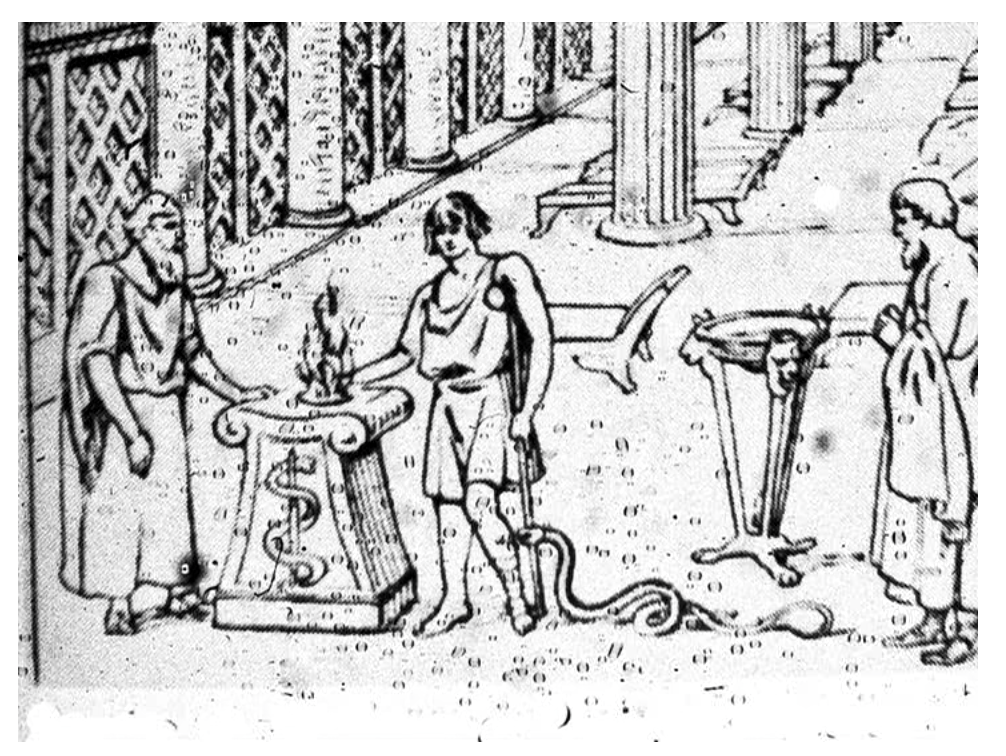
[Image Description: Illustration of wound-licking snake in an outpost of the cult of Asklepius (Asclepius), screenshot taken from a lecture by Wolf Wolfensberger on the historical architecture of care spaces.]
Artie Vierkant 50:20
It is a very funny picture.
Beatrice Adler-Bolton 50:20
It's hilarious, but, you know, they thought snake licking cured diseases. And they also thought that keeping people separate and keeping them in these sort of incubation chambers cure diseases. And it's like, well, what was actually working? Was it the snake?
Artie Vierkant 50:20
They had one of them right at least, yeah.
Beatrice Adler-Bolton 50:20
Right. Exactly. And so it's --
Phil Rocco 50:20
But snakes are cool [laughing].
Beatrice Adler-Bolton 50:20
Snakes are cool.
Beatrice Adler-Bolton 51:29
No, but I think this is the thing is that I think one of the sociological aspects -- now we're just fully talking about the way that the meaning making class understands, but I feel like one of the sociological aspects that just pandemic or not, is central to that experience, is to distrust your intuition about things and to instead listen and listen to and derive meaning from the sort of reduced epistemic understandings of the world.
So like, for example, you might look at some statistic that's like, oh, well, actually, this is -- actually has performed so much work sociologically in this world. But like, actually, wages grew between 2019 and 2020, 6.9% for the median worker. It's like, yeah, they grew because most of the people who were in low wage work were out of work in 2020, so they grew because that baseline was just ripped away. But the point is, you don't even need to think about that, if you are even casually observant about what's going on in the place where you live in any remote way, if you are able to listen to your senses as a way of experiencing the world, you will know that things are not getting better for people.
But the point is, and I feel like that's the function of these sort of -- the Atlantic essay and these other objects that can put in front of yourself, is to somehow dissuade you from trusting your senses, is to somehow dissuade you from trusting your senses and to instead believe that actually, you know, it's going to be like the flu and that means that everything will be fine. And that like that's the flu test, we'll just do the flu test, and if it's like the flu, then we're good.
Artie Vierkant 55:11
That's a horrible line, yeah.
Phil Rocco 55:12
Yeah, it's -- I think that -- and that's like what I feel is the most dangerous, not because I'm somehow above this or outside of it, because I've, I think, felt some of those same impulses and I felt some of those same desires to move on and to --
Beatrice Adler-Bolton 55:35
Of course.
Phil Rocco 55:37
It's, I think, quite a natural thing to say, not forgive necessarily, but certainly to forget. And I think that's where some of the greatest danger lies, not merely because it might mean that we actually miss the opportunity that exists right now to alleviate more suffering, but then if we learn nothing, the next time this happens, and it assuredly will, and probably not very long from now -- and who knows, maybe even just epidemiologically, we won't -- won't even be that much of an experience to change, but that we will have learned nothing, that we will do in fact the same thing, and that we will become even more fully than we are now, a society built around this huge sacrificial ritual.
Artie Vierkant 56:29
Right. Well, and we are still in a moment where we could at the very least curtail a huge amount of suffering. But instead, the conversation has shifted to kind of like two things. One is literally this week, shortly -- I think it was shortly before we hit the official 500,000 death tally, there were all these headlines about, like, economists think that there's going to be a boom after, you know, that people -- that there's so much untapped spending power from all of this -- from all of this time of everyone being shut in, that there will be this huge economic boom after. As we said at the very -- at the -- like, very early on in this, unfortunately, I think our political economy finds it much more convenient and easier to erect a monument than it does to make any substantial, proactive changes to stop something from becoming the kind of thing that needs to be eulogized. But you have -- you have that.
And then, on the other hand, this thing which you mentioned, Phil, which is I think really important, which is this emerging line, which the more that you see it, like, resist this or just -- or call it out when you see it -- but the idea that the goal in some way should be to reduce the impact of COVID-19 simply to about like what the flu does every year, to to reduce it to the level of what itself is already -- like the influenza is already one of the leading causes of death, right?
Beatrice Adler-Bolton 58:11
Yeah.
Artie Vierkant 58:11
To reduce it to something like that, which is basically to say, to accept a forever pandemic, right? To accept it, to just say that this is what -- this is what -- this is just reality now. There are a lot of problems with that, includcoviding the fact that, again, the flu is a leading cause of death. So if you're reducing it simply to that amount, you are basically saying, okay, so you know the amount -- the tragic amount of deaths that we already get from the flu every year, let's just double that, whatever, as though that's -- as though that's just fine and there's nothing that we should -- as though it's not some -- as though it's not our societal responsibility to do something about the flu deaths in the first place.
Among the problems with that is that if you know anything about how influenza deaths are counted, it's an -- influenza deaths every year, at least in the United States and certainly in a number of other countries, but influenza deaths every year are famously poorly counted. They are essentially counted, it's a -- you know, it is a complex process, but one of the ways that they are basically counted is through -- you look at excess mortality. And there's essentially formulas that you use to deduce what the impact of the seasonal flu was that year, right?
My point is, what you're essentially saying when you say -- to essentially naturalize COVID as though it is the same as the flu, or naturalize COVID as acceptable at the same level of deaths as the flu, is to basically say, you know, after a certain point, surveilling the spread of this, not really our problem anymore. Surveilling the amount of deaths to this, certainly something you want to pay attention to a little bit, but we can just calculate it -- you know, we can just do an estimate of it.
Phil Rocco 1:00:06
No, I mean, it's -- the act of thinking that is involved in that is actually quite understandable, right, which is to say, apparently, we tolerate this number of deaths every year from the flu. Sociologically speaking, it doesn't seem that the mass of people have any sort of problem with that. Flu deaths are, for example, not correlated to presidential approval ratings in any meaningful way. No one is ever held to account and forced to pay the piper for flu deaths. In fact, look at the number of articles that are released every year about them. It's minuscule.
So by that, we can conclude that it doesn't really matter if we don't do anything about COVID, as long as it's like that other thing that we don't give a shit about. And I think this is like -- you know, this is the thing -- I mean, this is not -- this phenomenon is not limited, though it is uglier, of course, with viral diseases, but it is not limited to those diseases. The same phenomenon applies to the way that we think about the housing crisis, for example, you know, after 2008, 2009.
A crisis in housing existed for Black Americans before that. When it began affecting people that the media seems to care about, that's when it became a crisis. And so, the same thing occurs here. It's a crisis in only one sense. COVID's a little bit different in the sense that it's a crisis in only one sense. It's a crisis in as much as it reduces the productive capacity of the economy. And now that we've demonstrated that we can get to a point where it essentially doesn't make a dent, that we can survive, that GDP can even do quite well with a large number of people who were unemployed, a large number of people who are getting sick and dying, you know, a mountain of bodies -- the GDP doesn't care. It's gonna do fine because we've figured out how to make that happen, then the crisis evaporates.
Beatrice Adler-Bolton 1:02:19
Yeah.
Artie Vierkant 1:02:20
Also, again, to this thing, this reality that we're creating, actively creating a reality where -- which is modeled off of what we already experience from influenza, from in other ways, like what we already experience with HIV/AIDS, right, which is that like -- so, for example, it's widely understood with influenza by clinicians as well as epidemiologists, that one of the reasons why it's so difficult to count is a lot of people don't -- like a lot of people who have the flu -- like count cases, much less count deaths -- is a lot of people who get the flu don't necessarily go seek medical attention. I mean, you might think perhaps one of the reasons that people don't do that, they just try to ride it out at home like it's just like a common cold or something is because --
Beatrice Adler-Bolton 1:03:07
Or they go to work.
Artie Vierkant 1:03:08
Or they go to work with it and continue to spread it is because, I don't know, maybe you've set up your entire political economy to disincentivize seeking any sort of medical help or health treatment, because you are so concerned that it will completely ruin you financially and ruin the rest of your life from like a medical bill, right? Yeah. I mean, this is the -- this is the future that I -- I mean, I think we all have been, and I certainly am, most concerned about, is that it becomes like influenza, like HIV/AIDS, where ideologically, a huge section of American culture is already arrived at the point where, like, oh, it's so sad, oh, it's unfortunate. And, oh, maybe there's some degree of risk in my life, but the degree of continued, substantive threat of immediate harm is unthinkable and unknowable to so many people, even though it's --
Beatrice Adler-Bolton 1:04:11
And they react violently to it, though.
Artie Vierkant 1:04:12
To people particularly who are well-off, right, is like unthinkable and unknowable to them, whereas --
Phil Rocco 1:04:19
Right. I think it's very important to think about how not to approach at a -- I mean, and when I say how not to, I mean intellectually, if you're thinking about this, or writing about it, or trying to process this experience even, I think it's very important to trust your intuition about how you should feel about these things. It's a better guide, I think, than the bromides from experts that things are getting better and that hope is just around the corner.
Because if you trust your intuition, what your intuition, I think -- I think for most people, even people who are like professional-managerial class, your instinct should tell you that the crisis existed before COVID, and that COVID brought it to light. COVID brought to light the crisis of having an economy that is so precariously balanced on this series of fictions about who takes care of whom, and what counts as a productive and profitable workforce, or even the idea that like what is the appropriate amount of work that someone should have to do for a particular wage, that all of these things were bound to fail us.
And the risk that you still feel, the nagging sense that this could all happen again, that this could be worse, that this could -- the baleful influence of this could and will persist, that is what should be structuring your belief. And it's not -- I don't say that because I think people should be distrustful of expert opinions by any means, right? But what I think is useful is to think really hard about the causal story that's being told here.
Because if you really think that it's just the fact that we didn't have a vaccine or that we were lacking an appropriate technical fix that is the reason why so many people had to suffer and die, is the reason why so many people lost their livelihoods, is the reason why that place that you like to go and eat is no longer open, is the reason why any number of like minor and even inconveniences that have collectively just put a damper on your life -- if you think that the reason for that is that we didn't have this one technical fix for the pandemic, the vaccine, or that we -- somehow it was just that like the instruments weren't set to like the right levels, if you think it was that, and not the broader set of institutional capacities we've set up and the -- culturally speaking, the way that our state and our economy force us to relate to one another -- if you don't think that that is somehow responsible, you will be in trouble again. You will feel these terrible things again, and you'll be waiting for a solution that is never going to come.
Beatrice Adler-Bolton 1:04:19
Mhm.
Artie Vierkant 1:04:19
Yeah.
Beatrice Adler-Bolton 1:07:43
It's like saying we just need to find the right type of snake to lick the wound and everything will be fine [Phil laughing]. I mean, I feel like this was a good spiritual successor to that conversation in July, because I feel like trying to actually talk through what these meanings that we're experiencing every day actually are constructed of has been really helpful for me personally, for not feeling like I'm just losing my mind every day when I look at the news. So I always appreciate these sort of stock taking episodes.
Phil Rocco 1:08:18
Yeah, that's mainly why I do this.
Beatrice Adler-Bolton 1:08:19
Yeah.
Phil Rocco 1:08:20
Yeah, I actually don't know if I didn't have this structured -- this is how like -- this is how like fucked up this way of organizing society is for my own mind, is that if I didn't have this structured moment in time where every week, I had to have a conversation about this on tape [Bea and Artie laughing], I actually don't know what I would be -- I think that I would just be like -- I think I would feel -- [sighing] I mean, I don't know if it's more kind of hopeless, but I think I would just -- like things would just be bubbling up inside me and I wouldn't really understand how to make sense of that. I would just sort of be plodding along. And so, yeah, I'm just -- I don't know if anything I said made sense, but certainly, I feel like I have a better sense of what's going on.
Artie Vierkant 1:09:02
I mean, that's kind of like the -- I feel that's the nature of not only these events, but also of the very -- and, you know, the way that these events show the structures that -- like the structures of our political economy that we talk about all the time, right, is just that part of it is that there are -- that there is so much that it becomes easier to stop trying to sublimate it or something you know what I mean? It makes it easier to --
Phil Rocco 1:09:26
It gives me a way of avoiding every temptation I have to adhere to the dictum of Oasis, to not look back in anger [laughter].
Artie Vierkant 1:09:43
Do Look Back in Anger, please.
Phil Rocco 1:09:45
Do indeed Look Back in Anger.
Artie Vierkant 1:09:47
The moral of the story is, Look Back in Anger.
Beatrice Adler-Bolton 1:09:50
Yeah, that's the thesis. Back and forward. I think that's a good place to leave it for today. Thank you for listening to the show. Please become a patron, patreon.com/deathpanelpod. We really appreciate the support. Appreciate that everyone does enjoy listening to the show.
As always, Medicare for All now, solidarity forever. Stay alive another week